Do not drink Chinese tap water without boiling it. Boil it and it is what the country itself drinks. The 19-litre jug delivered to your door costs RMB¥20–28 with a refundable RMB¥30–50 deposit on the empty, and a 550 ml bottle from any convenience store fridge costs around RMB¥2.
two objects appear in nearly every chinese kitchen, office and hotel room, and together they explain the entire water system better than any advisory page. the first is an electric kettle, usually already full. the second is a freestanding dispenser with an upside-down blue polycarbonate jug on top, holding nineteen litres. locals drink from one or the other, almost never from the tap, and the habit is not paranoia. it tracks the actual weak point of the system, which is not the treatment plant. it is everything that happens after the water leaves it.
What the national standard guarantees
china's drinking water standard is GB 5749-2022, issued by the market regulator and the standards committee on march 15, 2022 and compulsory since april 1, 2023, replacing the 2006 edition. it applies to every kind of piped supply, urban and rural, and to secondary supply, which is the term that will matter to you in a moment. the 2022 revision restructured the indicator list from 106 items down to 97: 43 routine indicators tested continuously, 54 extended ones checked on rotation, with four new contaminants added including the two compounds responsible for musty smell, and tighter limits on eight existing ones such as nitrate and turbidity. the standard's five baseline requirements are plain: no pathogenic microorganisms, no harmful chemicals, no harmful radioactivity, acceptable appearance and taste, and disinfection must have happened.
so the water leaving a municipal plant is, by law, tested and disinfected. the china cdc's own public guidance, published for world water day 2025, states the limitation next to the guarantee: distribution pipes can re-contaminate water on the way to your building. old grey cast-iron mains corrode and scale from inside, develop cracks, and let bacteria in through the gaps. that is why the same agency recommends drinking boiled water rather than raw tap water, in those words, as ordinary household advice and not as an emergency notice.
The building's tank: the last hundred metres
most residential towers taller than a handful of floors do not receive water straight from the main. the municipal pressure cannot push water to the twentieth floor, so the building stores it: a rooftop tank, a basement cistern, or both, from which pumps push it upward. this stage is called 二次供水, secondary supply, and it is the part of the system that depends on your specific building's management rather than on the city.
the rules for it are concrete, at least in the cities that enforce them. shanghai's drinking water regulation requires the building manager to test secondary supply water quality every quarter and post the results for residents, and to clean and disinfect the storage tanks at least twice a year, with two days' notice before the cleaning and a written announcement within 24 hours after. skipping the schedule is not theoretical: a shanghai office building was fined in 2026 after inspection found its tanks had gone two years without cleaning. the fines run from RMB¥1,000 to RMB¥5,000 per violation, up to RMB¥20,000 when a case is serious.
for you the practical read is short. the plant's work is uniform across the city; the tank's work is only as good as your 物业, the building management office. in a new tower with a well-run management company, the tank is cleaned on schedule and notice appears in the lift. in an old walk-up with a sleepy one, the tank is the variable. when you rent, the questions worth asking the agent are how old the building is and when the tank was last cleaned, and the mechanics of getting a straight answer out of an agent are in the renting guide.
The kettle and the boiling habit
boiling is the free half of the solution and the part the entire country has done for generations. the cdc's figure is specific: one to three minutes at a full boil kills 99.9 percent of the bacteria that matter, e. coli and salmonella among them, and drives off the chlorine that makes treated water taste like a swimming pool. an electric kettle does this in four minutes and costs RMB¥60–150 from any supermarket or the appliance section of the shopping platforms. every hotel room has one. every train carriage and station concourse has a scalding-hot water dispenser marked 开水, free, refilled constantly, because the habit is national infrastructure.
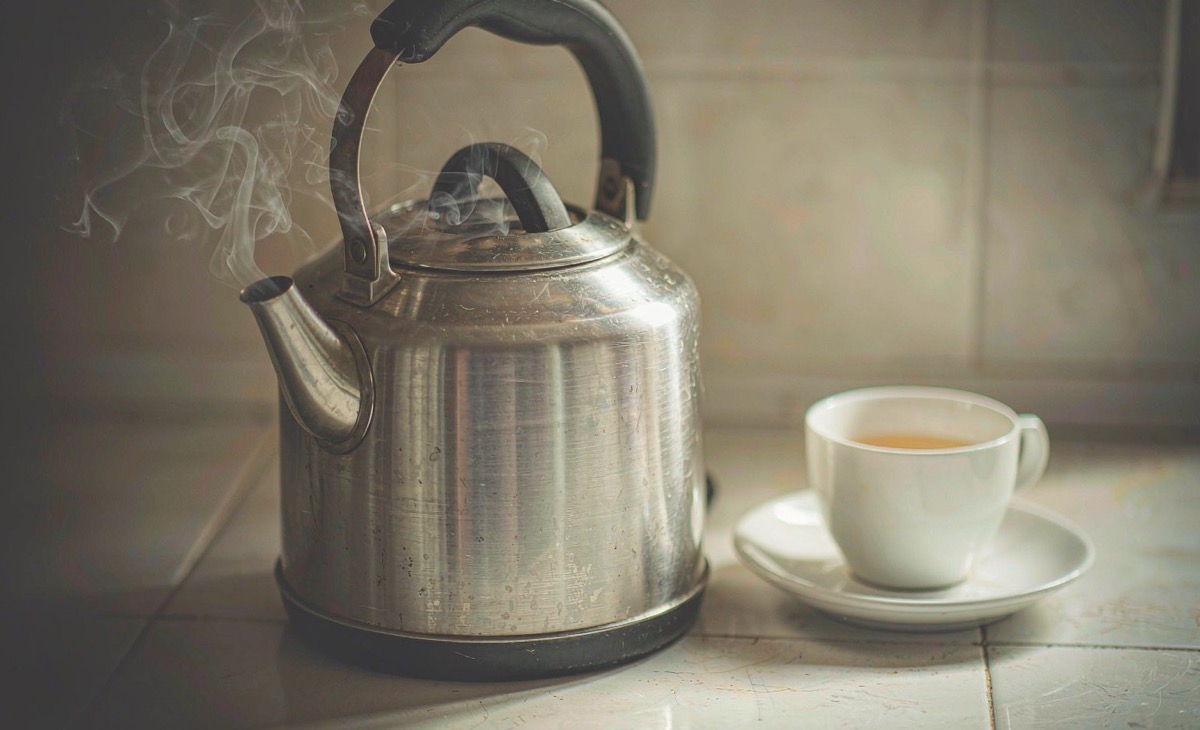
what boiling does not do matters as much. it kills organisms and volatilises chlorine; it does not remove anything dissolved. minerals stay, and so would dissolved metals, which is why the cdc directs anyone worried about heavy metals to a filter rather than to a longer boil. the white crust that builds up inside a kettle, 水垢, is calcium and magnesium precipitating out of hard water, and the cdc's position is that it is harmless at standard-compliant concentrations, merely unaesthetic. two more everyday sightings deserve a name: tap water that runs faintly yellow on the first draw of the morning is iron that settled in the pipes overnight and clears after the tap runs a few seconds, and water that comes out milky white and clears from the bottom up is dissolved air, not contamination. the cdc's advice on the yellow case is to let it run; its advice on persistent colour, cloudiness that does not clear, or any smell is to stop using the water until the building answers for it.
Three ways to buy drinking water
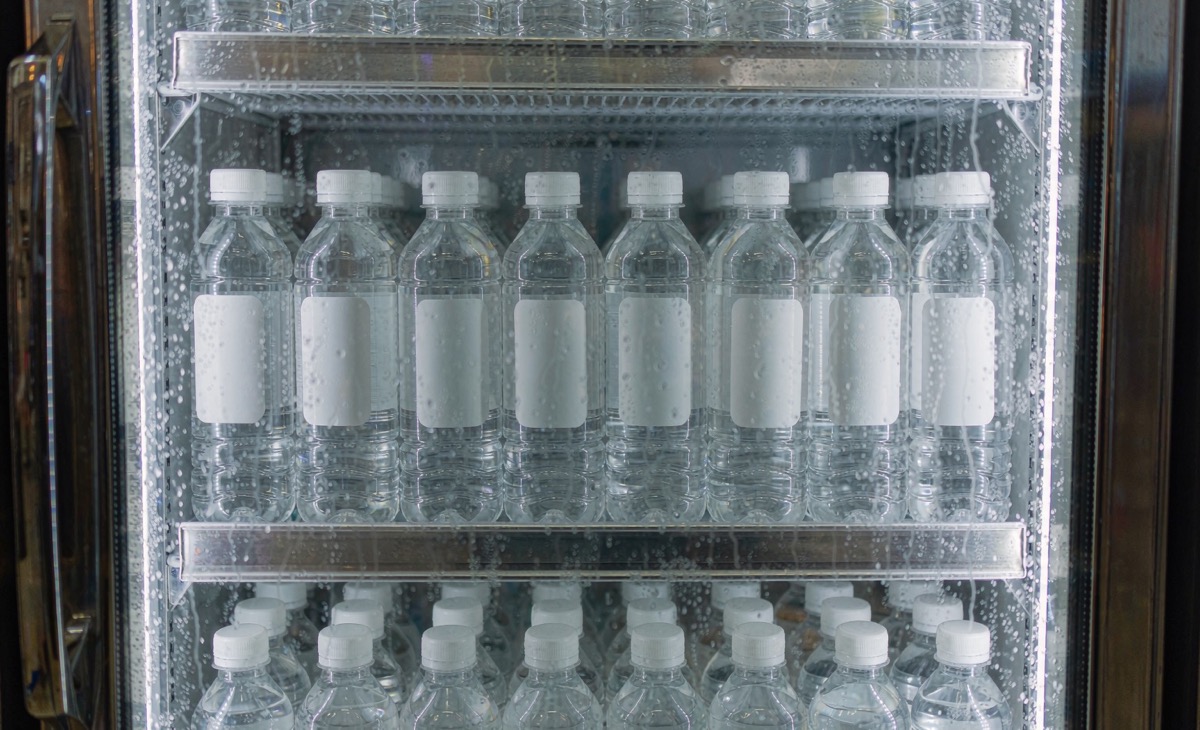
the first is the bottle. 550 millilitres of purified or mineral water from a convenience store fridge runs about RMB¥2 for the mass brands: nongfu spring with the red cap, c'estbon in green, ganten bai su shan, wahaha. convenience stores, supermarket chains, vending machines and the drinks fridges of every e-commerce delivery rider's route carry them; the bottle is the default when you are out.
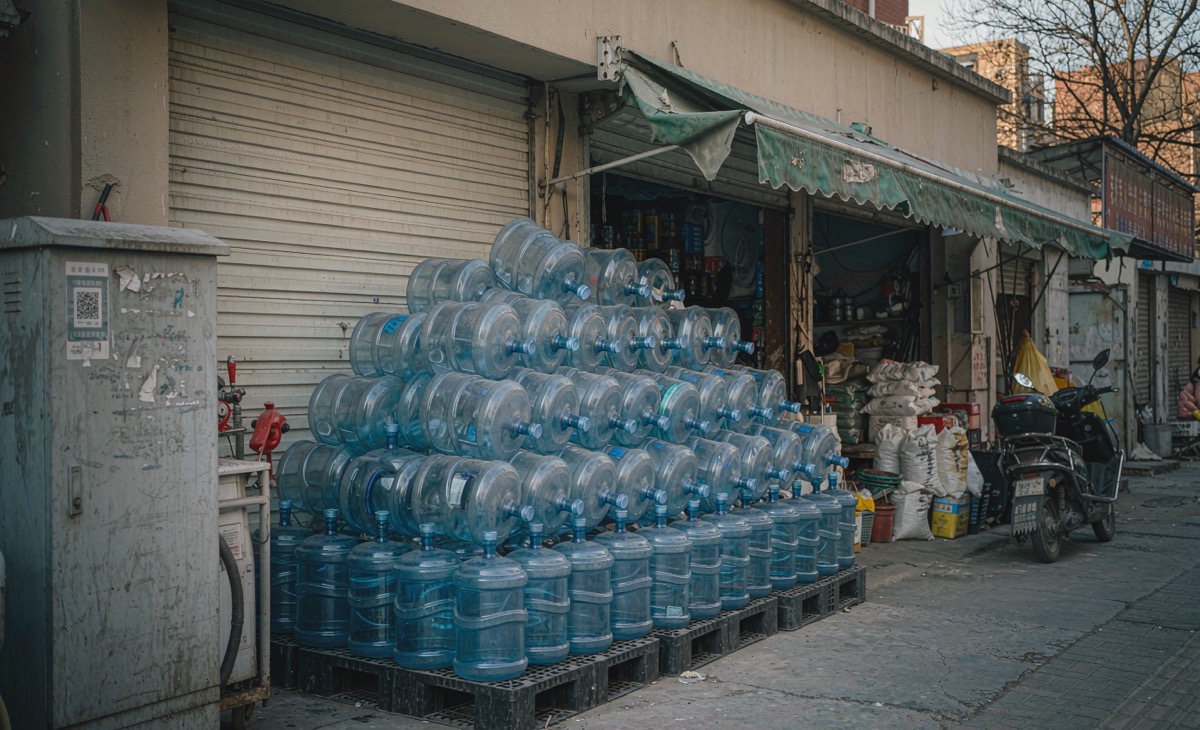
the second is the jug, and it is the residential default. a 19-litre polycarbonate bottle of nongfu spring delivered to an apartment door costs RMB¥25–28 in most cities; c'estbon's 18.9-litre runs around RMB¥22, wahaha's 16.8-litre around RMB¥20. the jug itself is never bought, only deposited: a refundable RMB¥30–50 per empty, returned when you stop the service. delivery is a phone call or a mini-program order away, typically same day and often within two or three hours, and most water shops sell 水票, prepaid ticket books, at a discount: buy fifteen jugs, get one free. the economics only work with a dispenser, the machine the jug upends into, which water shops supply free or rent out with hot and cold taps. one person drinking two litres a day empties a jug every nine or ten days, so the rhythm of the system becomes visible: three jugs a month, a new one upside-down on the dispenser before the last one runs dry.
the third is the street machine. the freestanding units outside convenience stores and inside residential compounds that dispense purified water into your own bottle for a few jiao per litre are a regulated category, 现制现售饮用水, made-and-sold-on-the-spot water. shanghai's rules for them are unusually legible: the operator must hold a hygiene licence, test the water at stated frequencies and file the results with the district authority, keep the machine's base ten centimetres off the ground and at least ten metres from garbage rooms, toilets and similar pollution sources, and keep it inside camera view. one official consumer advisory is worth quoting in spirit if not in translation: the water is produced without long-term storage conditions, so buy it fresh and boil it before drinking; it is not recommended to drink it raw. even the purified-water machine gets the kettle treatment.
What a month of water costs
the options are not equivalent in convenience, and the table puts their monthly arithmetic side by side for a one-person household drinking two litres a day.
| Option | Upfront | Monthly | The catch |
|---|---|---|---|
| Boiled tap water | RMB¥60–150 kettle | ≈ RMB¥0–5 electricity | does not remove dissolved metals; taste varies by building |
| 19-litre jug delivery | RMB¥30–50 jug deposit + dispenser (often free) | RMB¥60–90, about three jugs | needs a delivery address and a top-up rhythm |
| Bottled, 550 ml | none | RMB¥200–240 | the expensive way to drink at home; plastic volume adds up |
| Filter pitcher or under-sink RO | RMB¥150 pitcher, RMB¥800–2,000 RO unit | RMB¥30–80 in cartridges | cartridge discipline; cheap filters mostly improve taste only |
most apartments settle on a combination: the jug for drinking and cooking, the kettle over everything, tap water for dishes and showers. the water bill itself, for the tap supply, is paid with the utilities cycle and is a small line item; the mechanics sit in the cost of living breakdown.
Restaurants, hotels, and ice
eating out inverts the household rules. restaurants put a pot of hot tea or warm water on the table unprompted, refilled for free, and nobody drinks tap water with a meal because nobody is offered it. asking for 冰水, ice water, will get you a pause and probably a cup of hot water, because cold water with a meal is not a default anyone grew up with. two exceptions to the free-tea norm: some guangdong restaurants list a 茶位费, a per-person tea charge of RMB¥2–10 that appears on the bill whether you drink or not, and high-end restaurants elsewhere may add a stated service charge instead. both are printed or announced, and the general rules for reading a bill and disputing one are in the refunds guide.
hotels are the easiest case: the kettle in the room is the intended water source, and one or two complimentary bottles appear daily in anything above the budget tier. the ice question sits in the middle ground. packaged ice cups, 冰杯, a summer fixture of convenience store freezers for RMB¥2–4, are factory-made food products; ice from international chains and shopping-mall restaurants is machine-made from filtered supply. street vendors' ice and any ice of unclear origin are where the tap-water caveat applies unmodified.
Hard water and the north
china's water hardness follows its geology loosely: supply in the north, drawn substantially from groundwater, carries more dissolved calcium and magnesium than the softer southern surface-water cities. for a newcomer the difference shows up as housework, not health. a beijing kettle grows a visible white scale layer within weeks where a guangzhou kettle barely films; shower doors spot; tea steeps slightly differently. none of it is a safety signal, and the descaling fix is the universal one, a cycle of dilute vinegar or citric acid through the kettle. anyone moving between cities should expect the taste of the local supply to change and should not read that change as a quality problem.
Your first week
a workable sequence, in order, for a newly arrived tenant or long-stay visitor:
buy a kettle the first day if the apartment lacks one, and until the jug arrives, boil and cool tap water or buy bottles. order the jug the same week: search the delivery mini-programs or ask the property manager for the nearest 水站, water station, and expect a deposit conversation on the first order. ask the 物业 when the building's tank was last cleaned; the answer, or the evasion, tells you which half of the system you live on top of. if you want a filter anyway, pitchers ship from the taobao and jd listings within days, and the packing guide lists which travel-size purifiers are worth carrying versus buying here. payment for all of it runs through the usual two apps, covered in the payments guide.
the last habit is the one worth keeping after the novelty fades: drink what the building drinks. boiled, jugged or bottled, and never straight from the tap, not because the treatment failed but because the hundred metres after it are the part no standard can see.
Common questions about drinking water in China
Can you drink tap water in China?
Not untreated. The supply leaving the plant complies with the compulsory national standard GB 5749-2022, but the China CDC's own guidance recommends drinking boiled water because distribution pipes and building storage can re-contaminate water on the way to the tap. The local convention matches the advice: boiled, jugged or bottled, never raw from the tap.
Is tap water safe in China after boiling?
Boiling for one to three minutes kills 99.9 percent of pathogenic bacteria and drives off residual chlorine, which is why it is the national default. It does not remove dissolved minerals or metals; a filter is the tool for those. For everyday drinking in a city apartment, boiled tap water is what most households have relied on for decades.
Can you drink tap water in Shanghai?
Shanghai's plant output and its secondary supply are both tightly regulated, with quarterly water quality tests and at least half-yearly tank cleaning required by municipal rule. The practical answer is unchanged: the city does not recommend drinking it untreated, and buildings vary. Boil it, or drink from the jug.
What happens if you accidentally drink tap water in China?
For most adults in a major city, one accidental glass usually produces nothing at all, since the water is disinfected at the plant and the risk is microbial, not chemical. Travellers with unadjusted stomachs are more likely to feel it. Persistent symptoms after any suspected water issue are a normal case for a clinic visit, and the routing is in the doctor guide.
How much does the 19-litre water jug cost?
RMB¥25–28 for nongfu spring in most cities, RMB¥20–24 for wahaha and c'estbon tiers, with a refundable deposit of RMB¥30–50 on the empty jug. Delivery is typically same day, often within hours, and prepaid water tickets discount the per-jug price. A dispenser usually comes free or rented with the service.
Why is hot water free everywhere in China?
Because boiling is the country's baseline water treatment, learned long before bottled water existed, and public institutions are sized for it. Trains, stations, airports, hospitals and offices maintain free scalding-water dispensers, and the habit carries the tea culture with it. The dispenser marked 开水 is a public utility, not a courtesy.
Do I need a water filter in China?
It depends on what you want removed. A filter is the right tool for dissolved metals and for taste, and an under-sink reverse-osmosis unit covers the widest range; a basic pitcher mostly improves flavour. If you boil or use jug delivery, a filter is a preference rather than a necessity.
Is ice in China safe?
Factory-made ice products from convenience stores and machine ice at international chains and mall restaurants are food-supply products and are generally treated as such by locals. Ice of unclear origin, such as at small street vendors, falls under the same caution as raw tap water and is easy to decline.